

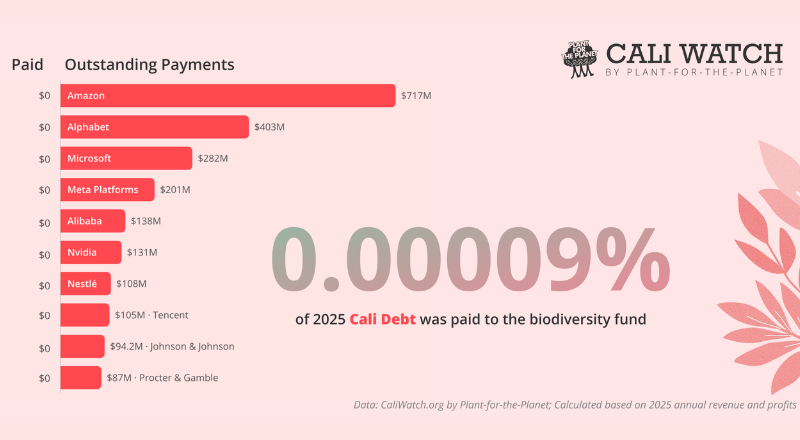

Tutzing, 12. October 2026. Only US$ 6,000 has been paid into the Cali Fund so far, while an estimated US$ 6.9 billion in contributions remains outstanding. The Fund was established to ensure that companies benefiting from genetic information derived from nature contribute to biodiversity protection.
Ahead of the UN Biodiversity Conference COP17 in Yerevan, Plant-for-the-Planet is launching Cali Watch (caliwatch.org) today, a public platform that shows which companies are expected to contribute, how much they have paid, and how much is still missing. The main reason for the lack of contributions is that no country has yet passed legislation making them mandatory. Cali Watch also monitors legislative efforts to introduce such requirements.
Cali Fund Press Briefing
Date: Wednesday, 14th October 2026
Time: 3.00 pm CEST
Location: Zoom. Please register here.
Speakers:
- Agata Makowska-Curran, Environmental Economics Ph.D. Candidate, London School of Economics and Political Science (LSE)
- Amber Hartman Scholz, Ph.D., Head of Science Policy, Leibniz-Institut DSMZ
- Felix Finkbeiner, Founder and Head of Forest Conservation & Public Policy, Plant-for-the-Planet Foundation
- Pakhi Das, Public Policy Advisor and Cali Watch lead, Plant-for-the-Planet Foundation
The Cali Fund: Sharing the Benefits of Biodiversity
The Cali Fund was established under the Convention on Biological Diversity (CBD) at COP16 in Cali, Colombia, and officially launched in Rome in February 2025. Its goal is to ensure that the benefits from the commercial use of digital sequence information (DSI) on genetic resources are shared fairly and equally. DSI is data about the genetic composition of living organisms, including plants, animals, and microorganisms. Companies in pharmaceuticals, cosmetics, agriculture, and AI-driven life sciences use this data to develop commercial products, from medications to drought-resistant crops.
Much of the genetic information used by companies comes from biodiversity-rich countries in the Global South. Yet the financial benefits generated from its commercial use rarely flow back to these countries or to the Indigenous Peoples and Local Communities (IPLC) who are the custodians of this biodiversity. The Cali Fund is an important step towards addressing this imbalance.
A Billion-Dollar Gap in Biodiversity Funding
Under the Cali Fund mechanism, large companies operating in sectors that benefit commercially from DSI should contribute either 1% of their profits or 0.1% of their revenue. However, contributions are currently voluntary. Nearly 19 months after the Fund’s launch, only two contributions have been confirmed, totalling US$ 6,000—far short of the estimated US$ 6.9 billion owed to the Fund, their ‘Cali Debt’.
The eighth companies with the highest estimated contributions each owe more than US$ 100 million and together account for around 30 percent of the total, or US$ 2.08 billion. Seven of these eight companies are from the technology and AI sectors.
The US is the only country—aside from the Vatican—that did not sign on to the Convention on Biological Diversity. If companies based in the US are excluded, total Cali Debt drops to US$ 3.34 billion.
Making the Contribution Gap Visible: Introducing Cali Watch
For the first time, Cali Watch makes this contribution gap visible. The platform provides an overview of:
- which companies have contributed to the Cali Fund,
- what companies are expected to contribute,
- how much they have already contributed, and
- how much remains outstanding for the year.
Responsibility for low contributions lies with governments
Cali Watch also includes a legislation tracker monitoring national efforts by governments to encourage or require companies to contribute to the Cali Fund. The international agreement establishing the Fund “invites” countries to take administrative, policy, or legislative measures that incentivize contributions. So far, no countries have introduced such legislation.
“The low Cali Fund contributions are foremost a legislative failure. It was clear from day one that the fund would only work once countries passed legislation requiring companies operating in their jurisdictions to invest into the Fund,” says Felix Finkbeiner, founder of Plant-for-the-Planet. “It’s embarrassing that not a single government has stepped up so far. I hope we will hear the first announcement during COP17.”
“Nonetheless, it is shameful that companies making billions on the backs of biodiversity are not contributing to protecting the basis for their business models. Some open questions about operational details are not an excuse”, adds Pakhi Das, Cali Watch lead at Plant-for-the-Planet.
Why the Cali Fund matters now
The Cali Fund is based on a new approach to benefit-sharing. Instead of trying to trace every genetic sequence back to its country of origin, users of DSI contribute to a collective fund, with the money distributed according to agreed criteria. At least 50% of the Fund’s resources will go to IPLCs, while the remaining resources will support developing countries, biodiversity research, and capacity-building related to DSI.
The mechanism is still taking shape. At CBD COP17 in Yerevan from 19–30 October 2026, governments are expected to set the final contribution thresholds and rates, adopt the formula for distributing the money and agree on how the effectiveness of the mechanism will be reviewed.
Explore Cali Watch: caliwatch.org
To get updates on the Cali Fund during COP17 on WhatsApp, click here.
About Plant-for-the-Planet
Plant-for-the-Planet is a global initiative for climate action founded in 2007 by then nine-year-old Felix Finkbeiner. Through climate education, the organization empowers children and youth to take action and has trained more than 100,000 climate justice ambassadors across 76 countries. In close cooperation with local communities, Plant-for-the-Planet drives the science-based restoration of biodiverse forests. Alongside practical restoration work, the organization develops open-source software for reforestation projects. Plant-for-the-Planet also engages in political advocacy for effective forest protection and global climate justice.
Media contact: Victoria Krumbeck | PR Manager | +49 8808-92108131 | [email protected]


