

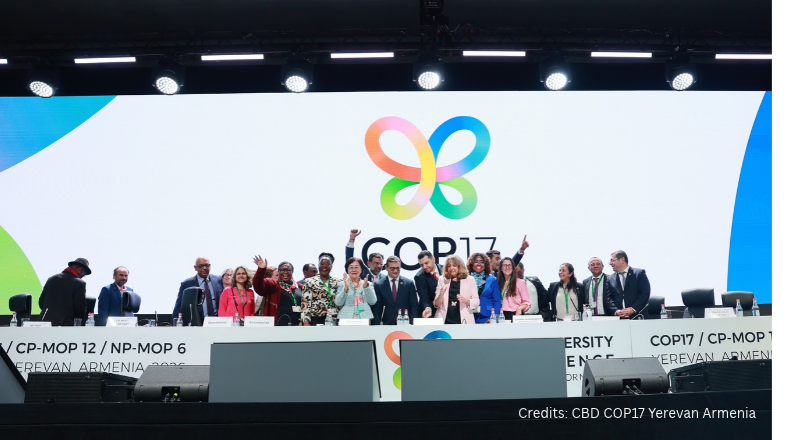

After two weeks of negotiations, parties adopted their decision on Digital Sequence Information moments ago. Our take away:
Companies should be contributing $6.8 billion a year to Cali Fund, to protect biodiversity. Only $10,588 have actually been paid. The minor progress made in the Yerevan decision, adopted at 5:25 am local time, is insufficient to lead to any meaningful contributions in the next two years.
The genetics of life on earth is the property of the countries in which it is found, according to a series of international treaties. Easy access to genetic data for researchers is essential for rapid medical and scientific progress.
Countries agreed to establish an international system – the Multilateral Mechanism – that would allow researchers to access genetic data on international databases. In exchange, the users, like biotech and AI companies, are expected to pay into an international biodiversity pot, the Cali Fund.
That money pays for biodiversity conservation without which genetic research would be impossible. The fund was established at COP 16, two years ago. The operational details were supposed to be decided at COP 17.
COP 17 negotiations deliver only modest progress on the Cali Fund
Despite efforts by some countries to slow the process and reopen already settled topics, the negotiations made modest progress, including:
- The fund can now become operational, since an allocation methodology for the use of funds was adopted.
- Only companies that contribute the official rate (1% of profits/0.1% of revenue) will receive a Cali Fund certificate.
Key Cali Fund decisions postponed until COP 18 in 2028
Unfortunately, key decisions about the workings of the fund were postponed until COP 18 in two years. This virtually guarantees that companies will face very little pressure to pay in and we’ll only see negligible contributions to the fund until at least 2028.
These key decisions include:
- Central terms, like “entity” and “direct or indirect use” or “DSI” have not been defined, making it very unclear which companies are expected to contribute to the fund.
- Whether companies using DSI data for only a small portion of their products are allowed to pay a lower rate.
“By punting essential decisions to two years from now, parties have all but ensured the fund remains empty until then”, says Pakhi Das, public policy advisor at Plant-for-the-Planet.
After talks stalled late Friday evening, key provisions were expected to be stripped from the decision text for reconsideration at SBI-meetings next year. Surprisingly, once a mildly modified presidency text version of the decision was brought up in the plenary a little after 5 am local time, the text was rapidly adopted without a single party suggesting modifications or even taking the floor.
Cali Fund success depends on national legislation, not COP negotiations
Right now, contributions to the Cali Fund are purely voluntary. Thus, barely any contributions have been made.
However, in the Cali Fund’s founding document from COP 16, countries also decided that national governments should pass legislation to make their companies contribute to the Cali Fund:
“Parties and non-Parties are invited to take administrative, policy or legislative measures, consistent with national legislation, to incentivize users in their jurisdiction to contribute to the global fund in line with the modalities of the multilateral mechanism.”
CBD decision 16/2, paragraph 13
To date, no country has enacted or even attempted to pass such legislation.
The remaining open questions, punted to COP 18, provide an easy excuse for countries to continue not to pass such legislation. However, it’s not a valid excuse.
Any country willing to pass such legislation, could introduce hb interim answers to the open questions that are in effect until the negotiation process is complete. For instance, the EU could decide for itself what constitutes “direct or indirect use of DSI” for the purpose of its legislation until an official CBD decision has been adopted.
“The success or failure of the Cali Fund won’t be decided at COPs, but in national capitals. If governments pass laws requiring companies to pay into the fund, it will succeed. If not, it will fail.” said Felix Finkbeiner, co-founder of Plant-for-the-Planet.
“If you stack potential Cali Fund revenues in $100 bills, it would reach the height of Mount Everest. If you stack actual contributions, they’re as tall as a flip-flop sole” he added.
Follow the latest Cali Fund developments
Join our Cali Fund updates WhatsApp channel.
Contact us with any questions:
- Felix Finkbeiner, co-founder of Plant-for-the-Planet and Head of Public Policy, [email protected] or +49 173 9128461
- Pakhi Das, Public policy advisor, [email protected] or +91 91 3669 394 0
Über Plant-for-the-Planet
Plant-for-the-Planet is a global initiative for climate action founded in 2007 by then nine-year-old Felix Finkbeiner. Through climate education, the organization empowers children and youth to take action and has trained more than 100,000 climate justice ambassadors across 76 countries. In close cooperation with local communities, Plant-for-the-Planet drives the science-based restoration of biodiverse forests. Alongside practical restoration work, the organization develops open-source software for reforestation projects. Plant-for-the-Planet also engages in political advocacy for effective forest protection and global climate justice.
Plant-for-the-Planet is a global initiative for climate action founded in 2007 by then nine-year-old Felix Finkbeiner. Through climate education, the organization empowers children and youth to take action and has trained more than 100,000 climate justice ambassadors across 76 countries. In close cooperation with local communities, Plant-for-the-Planet drives the science-based restoration of biodiverse forests. Alongside practical restoration work, the organization develops open-source software for reforestation projects. Plant-for-the-Planet also engages in political advocacy for effective forest protection and global climate justice.
Plant-for-the-Planet is a global initiative for climate action founded in 2007 by then nine-year-old Felix Finkbeiner. Through climate education, the organization empowers children and youth to take action and has trained more than 100,000 climate justice ambassadors across 76 countries. In close cooperation with local communities, Plant-for-the-Planet drives the science-based restoration of biodiverse forests. Alongside practical restoration work, the organization develops open-source software for reforestation projects. Plant-for-the-Planet also engages in political advocacy for effective forest protection and global climate justice.
About Plant-for-the-Planet
Plant-for-the-Planet is a global initiative for climate action founded in 2007 by then nine-year-old Felix Finkbeiner. Through climate education, the organization empowers children and youth to take action and has trained more than 100,000 climate justice ambassadors across 76 countries. In close cooperation with local communities, Plant-for-the-Planet drives the science-based restoration of biodiverse forests. Alongside practical restoration work, the organization develops open-source software for reforestation projects. Plant-for-the-Planet also engages in political advocacy for effective forest protection and global climate justice.
[email protected] | +49 8808 92108131


