

September 28, 2026

Plant-for-the-Planet
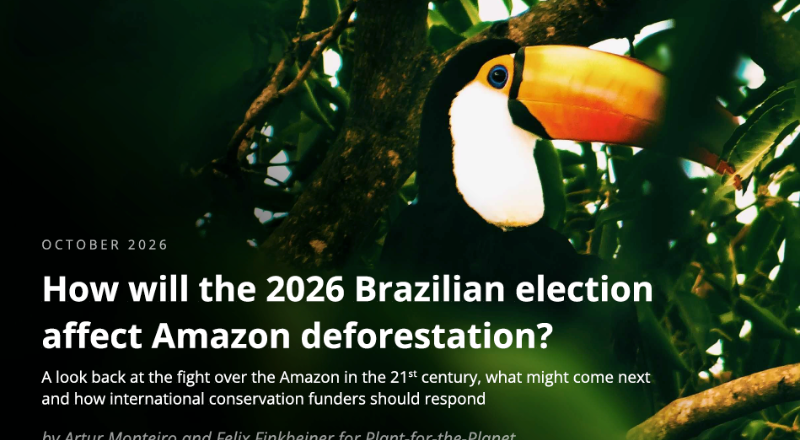
Berlin, 28 September 2026. Brazil’s presidential election on 4 October could have far-reaching implications for the future of the Amazon rainforest. Around two-thirds of the Amazon rainforest lies in Brazil. The political direction of the next government will have a major influence on how Brazil addresses deforestation, forest protection, and international cooperation to protect the rainforest. An analysis by Plant-for-the-Planet examines the different policy approaches of the two camps led by President Lula da Silva and challenger Flávio Bolsonaro, and what they could mean for the Amazon.
Invitation to online press briefing
Ahead of the first round of the presidential election, Plant-for-the-Planet is hosting a press briefing to present and discuss the findings of the report in detail.
Date: Tuesday, 29 September 2026
Time: 2:00–3:00 pm CEST
Location: Online via Zoom. Please register here.
Speakers:
- Artur Monteiro, Brazilian forest policy researcher, Freie Universität Berlin
- Felix Finkbeiner, founder and head of restoration and conservation and public policy, Plant-for-the-Planet Foundation
- Ana Paula Valdiones, expert on deforestation-free supply chains, Instituto Centro de Vida (ICV)
Analysis: The future of the Amazon rainforest after the election
“Brazil’s declining deforestation rates since Lula took office show that forest protection backed by political action can work. The upcoming election will determine whether Brazil continues on its current path of forest protection,” says Felix Finkbeiner, founder of Plant-for-the-Planet and head of restoration and conservation and public policy.

The report published today by Plant-for-the-Planet compares the forest policies of the center-left alliance led by President Lula da Silva (Partido dos Trabalhadores, PT) with those of the right-wing camp represented by Flávio Bolsonaro (Partido Liberal, PL). It focuses on policy decisions that are particularly relevant to protecting the Amazon: effective control of deforestation and enforcement of environmental laws, recognition of Indigenous territories, and the expansion of agriculture in the Amazon region.
Please find the report here.
Deforestation under Bolsonaro and Lula
Lula’s record so far shows a significant decline in deforestation rates. His government has taken a more climate-oriented approach, including through the influence of Environment Minister Marina Silva and the strengthening of environmental agencies such as IBAMA. At the same time, the Plant-for-the-Planet analysis shows that a left-wing government will face significant challenges in achieving its stated goal of ending deforestation entirely by 2030. These include limited financial resources and the strong influence of the agribusiness sector in the Brazilian Congress.
Based on the record of Jair Bolsonaro’s previous government and the political coalition around his son Flávio, another Bolsonaro administration would carry a higher risk of undermining forest protection agencies. Other potential consequences include no new protected areas or Indigenous territories, increased incentives for illegal deforestation through amnesties, and a possible retreat from international cooperation on forest protection.
The importance of the Amazon extends far beyond Brazil
“The significance of Brazil’s election extends far beyond the country’s borders. International cooperation to protect the Amazon is also at stake. Instruments such as the EU Deforestation Regulation (EUDR), which will enter into force at the end of the year, REDD+ programs and the Tropical Forest Forever Facility (TFFF) offer major opportunities to protect the Amazon. Constructive cooperation with the Brazilian government will be essential to making these mechanisms work,” says Finkbeiner.
The Amazon rainforest is of critical importance to the global climate. It stores vast amounts of carbon and, through its enormous water cycle, influences the climate far beyond the region. At the same time, the Amazon is one of the most biodiverse regions on Earth and is therefore of outstanding importance for global biodiversity.
You can find the graphics from the report here.
About the authors:
Artur Sgambatti Monteiro, lead author, is a Brazilian expert in environmental governance and international cooperation with more than 15 years of experience across the Amazon, Latin America, Europe and Africa. His work focuses on environmental management, climate and nature finance, jurisdictional REDD+ approaches, sustainable landscapes and social safeguards. He is currently pursuing a PhD at Freie Universität Berlin.
Felix Finkbeiner, co-author, founded Plant-for-the-Planet at the age of nine. As head of restoration and conservation he is responsible for the strategic development of restoration projects. He also leads the public policy and advocacy team, which focuses on international mechanisms for protecting tropical forests, including the TFFF and EUDR.
About Plant-for-the-Planet
Plant-for-the-Planet is a global initiative for climate action founded in 2007 by then nine-year-old Felix Finkbeiner. Through climate education, the organization empowers children and youth to take action and has trained more than 100,000 climate justice ambassadors across 76 countries. In close cooperation with local communities, Plant-for-the-Planet drives the science-based restoration of biodiverse forests. Alongside practical restoration work, the organization develops open-source software for reforestation projects. Plant-for-the-Planet also engages in political advocacy for effective forest protection and global climate justice.
Media contact: Victoria Krumbeck | PR Manager | +49 8808-92108131 | [email protected]


