

September 3, 2026

Zeinep Ibragim Kyzy
A regular, floody day in The Gambia.
It is 9 am on a September Tuesday on the “Smiling Coast of Africa”. The dry season has long passed and so the tourists have emptied the city, but something else has replaced their presence. Cats and dogs. More literally, rain. Rain that seems to seep into the earth then pollutes the sidewalks, then streets and then, even Mohammed’s whole backpack and homework notebooks as he scrolls up his brown pants to walk to school.
The Gambia is set to experience sea level rises, with some provinces predicted to be fully underwater by the end of this century. Experts warn that, without urgent action, Banjul will be submerged, displacing thousands and placing many families in precarious conditions.
Mohammed does not know much of what experts predict. He knows that the floods are annoying, sometimes fun when he gets to miss school and not see the English teacher whose words sting like mosquito bites.
He knows that the color of his pants match the color of the flood water. He knows that during the rainy season there are more mosquitoes, so life outside of school and inside school is utterly indistinguishable. He will soon know Sulayman, who he will help clear out the drainage that is exposed to floods and breeds mosquitoes.
How do people get involved in climate justice?
Sulayman Njie, our empowerment coordinator, became part of the climate movement when he was not much older than Mohammed now (around 7 years old). For him, and many others in climate vulnerable countries, the climate crisis was something that manifested very clearly in his daily environment. Floods, mosquitoes and warming temperatures that he could not look past.
However, Sulayman had someone to look up to from early on. He was, in school, inspired by a student named Fatou Jeng, now one of the biggest Gambian youth climate activists and Plant-for-the-Planet’s International Empowerment Manager. He agrees it took that one relationship opening a door, alongside simply living through the impacts himself, to set his path.
In Banjul’s flooded streets, thick with mosquitoes bred in exposed drainage, he watched his neighbours clear ditches by hand, a routine that kept the sickness down and kept the city livable. This taught him early that looking after the environment was simply part of daily life. “Living within that community, being groomed by our own rules around awareness, I developed a liking for community work, community mobilization, working in teams to keep my environment clean,” he says. By grade seven he was reading predictions that Banjul, built partly on reclaimed wetland, could lose its inhabitants entirely if nothing changed. So he and his friends started their own weekend beach cleanups, then moved into the mangroves and the Tanbi Wetland, land that still makes up more than a third of Banjul and absorbs water that would otherwise flood the city.
Fourteen years later, he runs empowerment programs in Banjul, mentoring students the same way he was once mentored, closing a circle that Fatou watched happen in real time. “It’s just that now he’s been empowered to become a full program coordinator,” she says, “continuing to empower young people the same way he was once supported and empowered by those before him.”
And now?
This past summer, funded by the World Bank’s West Africa Coastal Areas Management Program (WACA), Plant-for-the-Planet ran Academies for 600 children across nearly thirty schools in the Kotu Stream area, a flood-prone stretch of Greater Banjul home to more than 200,000 people. Fatou coordinated the project and Sulayman and a newer colleague, Dembo Bojang, ran the sessions on the ground. Dembo, who signed his contract with Plant-for-the-Planet only in March, arrived with a familiar origin story of his own: monthly village cleanups as a child, then a flyer for a Banjul cleanup years later that felt, in his words, like “what I’ve been doing,” and a fast climb from volunteer to program coordinator.
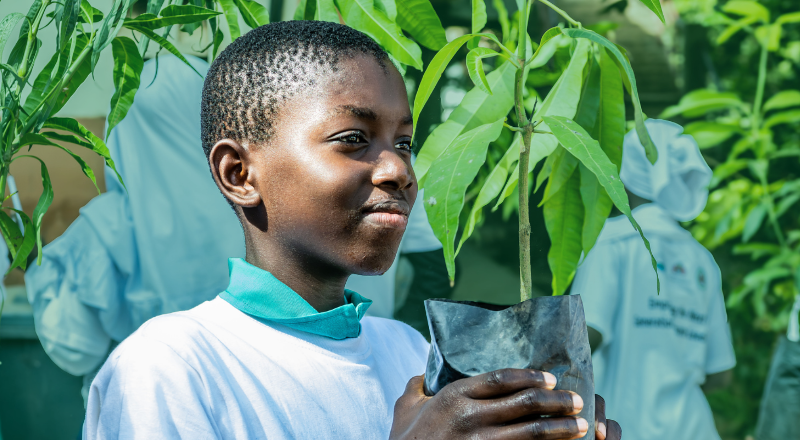
What made the Academies work, all agree, was moving children out of the classroom and into the places the lessons were actually about. “The Academies are often quite theoretical,” Fatou explains, “students don’t always get to see exactly what we’re talking about.” So mentees walked the Kotu Stream barefoot, saw the waste clogging its flow, and understood why the water flooded their own streets.
How being in the right space brings new ideas:
People, like plants, need fertile ground to grow on. The Academies offer this ground for creative climate solutions.
“It came entirely from the children themselves,” Dembo grins, as he tells us about how one student worked out that charcoal, the fuel most Gambian households still cook with, could be made from waste instead of cut timber, an idea Dembo checked afterward and found was genuinely workable. “That was, for me, one of my favorite ideas.”
And indeed, reflecting on the Academies, it seemed like our coordinators benefited just as much from them as the children did. When students visited the site of 14,000 coconut trees Plant-for-the-Planet had helped plant along the coast, they came to a version of the same idea from a different angle: seedlings cost six to seven dollars each, but surviving trees produce their own seeds, and roughly half of that original planting has already regrown itself for free. Some students believed it enough to act on it themselves. Sulayman proudly mentioned that a few of them are still in contact with local seedling suppliers, planning restoration work of their own, well beyond the Academy timeline.
How much better would the world be if everyone could just sit down together and brainstorm what we could do to solve our current problems? It seems like solutions are often on the tip of our tongues, but no one offers the patience to hear them out. Academies create a safe space for children to express their concerns, share their experience of climate change and propose solutions that they can jump to now. We sincerely wish we could offer Academies for adults, if only so the people writing this blog could attend one ourselves.
And a climate action network there shall be.
The program did not and shall not end when the Academies did/do. For instance, at one school, participants started their own environmental club within weeks, complete with a head boy who told Fatou the training had made him want to work in sustainability. Other schools sent Dembo videos of themselves planting more trees on their own, unprompted. Sulayman still runs a WhatsApp group with the teacher coordinators he trained, and one participant messaged him just this week to say she wants to make a video about what she learned. Two young people from this summer’s cohort have been selected to travel to Frankfurt for Plant-for-the-Planet’s Youth Summit in September, and several more have applied to represent their schools at LCOY, a national children’s climate conference, where their statements will be folded into the country’s official record.
Give children the chance to see the problem up close, and the chance to be taken seriously when they propose a solution, and you shall have a living, breathing climate network that actively changes our future.
Who is Mohammed?
Mohammed is a fictitious character. But millions of real children are already living through the consequences of global warming, and millions more will inherit them.
Like forests around the globe, The Gambia’s land and forest sector has flipped from a net carbon sink to a source. If deforestation continues at this rate, the government itself warns there will be no forests left by 2050. No forests at all. Will that land still hold back the floods? Will there be any mangroves left to do it? Even children can answer that question.
There’s an old idea that any peasant working the fields could have been a great artist, if only they had the time. The same is true of children. Somewhere among them is the next big voice, a Greta Thunberg or a Felix Finkbeiner waiting to rise to the occasion, and we lose them the moment we think their voice cannot have an impact. Who knows? Perhaps our Mohammed can change the world.
Our empowerment program exists to bring young Mohammeds, Fatous, Sulaymans, and Dembos, and every child like them, together, and show them, early, that they can accomplish anything.
Interested in learning more about our empowerment program? Visit our website!
Thank you to Dembo Bojang, Fatou Jeng, and Sulayman Njie for sharing their time and stories for this interview!
 10.05.26
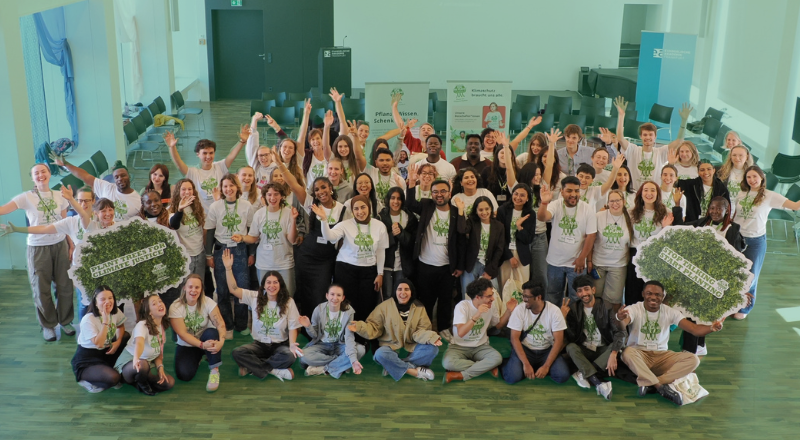
Youth Summit 2026: Stronger together for climate, community and democracy
Centered around the theme “Stronger together: climate, community, democracy”, around 60 participants from more than 15 countries representing 6 continents came together this year…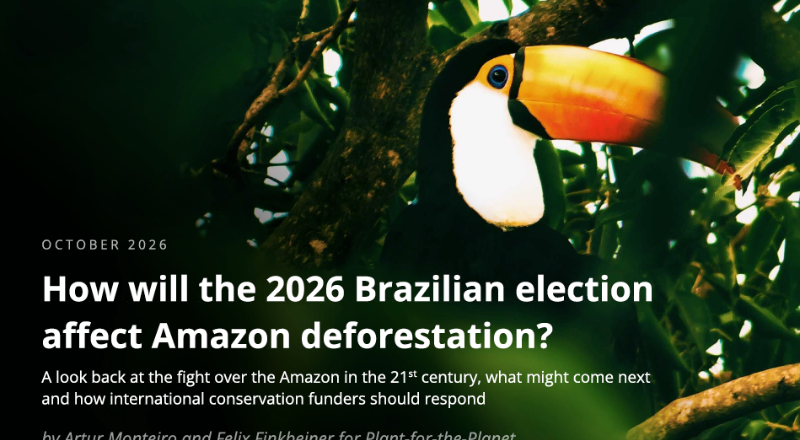 09.28.26
Brazil’s 2026 Election: What Does It Mean for the Future of the Amazon?
Brazil’s presidential election in October 2026 could have far-reaching consequences for the future of the Amazon rainforest. With almost two-thirds of the Amazon located… 09.22.26
Climate Myths from the Comment Section
As early as 1912, it was publicly reported that the increasing burning of fossil fuels could alter the concentration of greenhouse gases in the… 09.15.26
Together, We Can Achieve More: Key Takeaways from the F20 Climate Solutions Forum 2026
Political space for action is shrinking, international consensus on climate action is becoming increasingly fragile, and geopolitical tensions are on the rise. At the…- 09.03.26
Why Climate Education for Children Starts with One Mentor or One Academy.
A regular, floody day in The Gambia. It is 9 am on a September Tuesday on the “Smiling Coast of Africa”. The dry season…  08.26.26
Restoring Landscapes: The Power of Agroforestry in Ghana
Restoration works best when it happens together with local communities. In many regions, people live in close proximity to ecosystems in need of recovery,…


