

September 28, 2026

Plant-for-the-Planet
Brazil’s presidential election in October 2026 could have far-reaching consequences for the future of the Amazon rainforest. With almost two-thirds of the Amazon located in Brazil, the political direction of the country’s next government will have major implications for deforestation, forest protection and international cooperation.
The election is about more than the presidency. In the same electoral cycle, Brazilians will also elect state governors, federal and state legislators, all seats in the Chamber of Deputies and two-thirds of the Senate. Together, these institutions will shape the political conditions for protecting the Amazon in the years ahead.
A new analysis by Plant-for-the-Planet examines the different political approaches of the centre-left coalition led by President Lula da Silva (Partido dos Trabalhadores, PT) and the far-right camp represented by Flávio Bolsonaro (Partido Liberal, PL). It looks at the issues that could have the greatest implications for the Amazon, including deforestation control, environmental enforcement, Indigenous territories, mining, oil extraction and agricultural expansion.
The Amazon is at a critical point
The Amazon has already experienced decades of severe forest loss. The deforestation rate began rising rapidly from 2012 and peaked at around 13,000 km² in 2021. Since then, annual deforestation has fallen to 5,731 km² in 2025. At the same time, an area larger than Germany has been deforested in the Brazilian Amazon over the past 30 years.
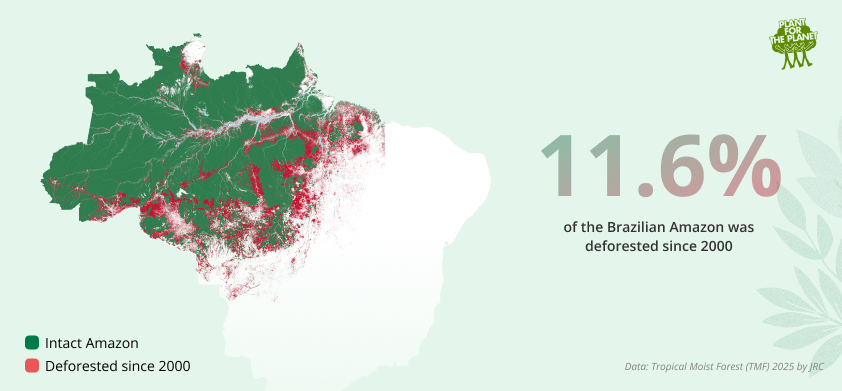
The recent decline shows that political action and environmental enforcement can make a difference. But whether this trend continues will depend largely on domestic political will, economic policy and international cooperation on forest conservation.
Key findings from the Plant-for-the-Planet analysis
The report identifies several factors that could shape the future of Amazon forest protection:
- Forest protection is supported by a range of existing institutions and mechanisms. Brazil’s Forest Code, protected areas, recognised Indigenous territories, internationally funded programmes and market-based initiatives all provide incentives for forest conservation. These safeguards limit how much deforestation could increase in the short term, meaning that deforestation rates are unlikely to immediately return to previous extremes.
- A future right-wing government could still substantially increase deforestation. This could happen by weakening the effectiveness of existing forest-protection institutions or encouraging further illegal deforestation through land amnesties that later legalise it.
- A future Lula administration would face significant challenges in ending deforestation by 2030. Limited financial resources and the strong influence of agribusiness interests through Brazil’s independent Congress could make it difficult to achieve this goal.
- The future of Indigenous territories is closely connected to the Marco Temporal debate. The outcome of the ongoing dispute over the historical requirements for recognising Indigenous territories will influence how many additional territories can be demarcated and effectively protected – and how much can be lost.
- International cooperation can make forest protection less dependent on federal election outcomes. International funders can strengthen conservation by working directly with states, Indigenous peoples’ and local communities’ organisations, NGOs and other sub-national actors.
- Private-sector and market-based initiatives can provide an additional layer of protection. Measures such as the Soy Moratorium and stronger traceability systems can help keep products linked to deforestation out of supply chains.
Deforestation under Lula and Bolsonaro
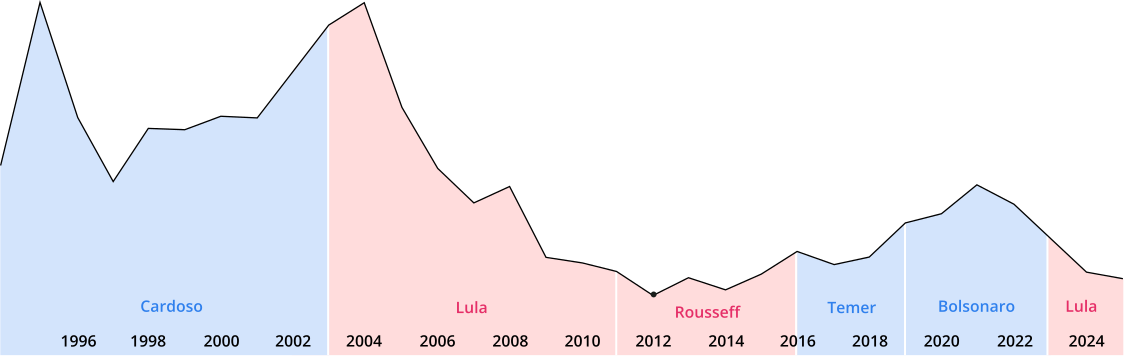
The different political approaches of the two camps are particularly visible in their records and positions on forest protection.
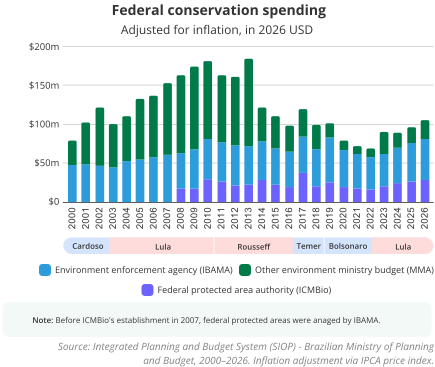
Lula’s current administration has taken a more climate-oriented approach. The government has strengthened environmental agencies such as IBAMA, and the influence of Environment Minister Marina Silva has contributed to the government’s forest and climate policies.
Under Lula, deforestation has fallen substantially. However, the government’s stated goal of ending deforestation by 2030 remains difficult to achieve. Limited financial resources and the influence of agribusiness interests in Congress are significant challenges.
The Plant-for-the-Planet analysis takes a different view of the potential direction of a future Bolsonaro administration. Based on the record of Jair Bolsonaro’s previous government and the political coalition surrounding his son Flávio, such a government would carry a high risk of weaker environmental enforcement.
Other potential consequences identified in the analysis include faster expansion of extractive and agricultural activities, no new protected areas or Indigenous territories, increased incentives for illegal deforestation through amnesties, and reduced engagement with international forest-protection cooperation.
Why the future of Indigenous territories matters
The protection of the Amazon is closely linked to the recognition and protection of Indigenous territories.
The Marco Temporal debate is therefore an important part of the report’s analysis. The ongoing dispute over the historical requirements for recognising Indigenous territories could determine how much additional land can be formally demarcated and protected.
At the same time, this issue demonstrates why the presidential election is not the only factor shaping the future of the Amazon. Brazil’s independent Congress plays a major role in shaping Marco Temporal and parts of the broader agribusiness agenda.
Could Amazon deforestation rise again?
Brazil’s existing forest-protection system creates important safeguards against a rapid return to previous levels of deforestation. The Forest Code, protected areas, recognised Indigenous territories, internationally funded programmes and market-based initiatives all contribute to forest conservation. But these mechanisms can still be affected by political decisions.
A future government could weaken the effectiveness of forest-protection institutions or encourage further illegal deforestation through land amnesties that later legalise it. This means that the future development of Amazon deforestation will depend not only on the laws and institutions that exist, but also on the political will to enforce and strengthen them.
At the same time, not all factors are controlled by the federal government. Congress, state governments and private-sector actors can also shape the future of forest protection.
The importance of the Amazon extends far beyond Brazil
The consequences of Brazil’s election reach well beyond the country’s borders. The Amazon plays a central role in regulating global temperatures and protecting biodiversity. Its future is therefore closely connected to international efforts to address the climate crisis and protect nature.
Brazil is also an important partner in international forest-protection cooperation. Instruments such as REDD+ programmes, the EU Deforestation Regulation (EUDR) and the Tropical Forest Forever Facility (TFFF) offer opportunities to create stronger incentives for protecting the Amazon.
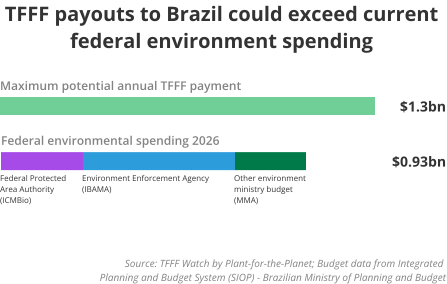
For these mechanisms to work effectively, constructive cooperation with the Brazilian government is essential.
Making forest protection more resilient to political change
The report also identifies ways in which international actors can support Amazon conservation regardless of changes at the federal level.
- Germany and other international rainforest donors can diversify forest cooperation by strengthening long-term partnerships with Amazonian states, Indigenous peoples’ and local communities’ organisations and civil society organisations.
- They can also prioritise stronger legal and institutional protection for forest-finance mechanisms, participatory safeguards and environmental enforcement capacity. This can make international cooperation less vulnerable to political changes.
- Market regulation and trade policy can provide another important tool. The EUDR, stronger traceability requirements and support for zero-deforestation supply chains can reinforce forest protection beyond government action.
- The TFFF is another key tool identified in the report for creating ongoing incentives to decrease deforestation.
What does the election mean for the future of the Amazon?
Brazil’s 2026 election comes at an important moment for the Amazon.
Deforestation has fallen significantly from its recent peak. But whether this decline becomes a lasting trend will depend on political decisions, the strength of Brazil’s environmental institutions, economic interests and international cooperation.
The presidential election will be important, but it will not determine the future of the Amazon on its own. Brazil’s Congress, state governments, Indigenous peoples, civil society, businesses and international partners will all play a role.
The Plant-for-the-Planet analysis examines these different factors and shows why the future of the Amazon depends not only on who governs Brazil, but also on how effectively existing forest-protection mechanisms are maintained and strengthened.
Read the full Plant-for-the-Planet analysis to explore the potential impacts of Brazil’s 2026 election on deforestation, Indigenous territories, forest protection and international cooperation.
Want to support our work? Find out more here.
- 09.28.26
Brazil’s 2026 Election: What Does It Mean for the Future of the Amazon?
Brazil’s presidential election in October 2026 could have far-reaching consequences for the future of the Amazon rainforest. With almost two-thirds of the Amazon located…  09.22.26
Climate Myths from the Comment Section
As early as 1912, it was publicly reported that the increasing burning of fossil fuels could alter the concentration of greenhouse gases in the… 09.15.26
Together, We Can Achieve More: Key Takeaways from the F20 Climate Solutions Forum 2026
Political space for action is shrinking, international consensus on climate action is becoming increasingly fragile, and geopolitical tensions are on the rise. At the… 09.03.26
Why Climate Education for Children Starts with One Mentor or One Academy.
A regular, floody day in The Gambia. It is 9 am on a September Tuesday on the “Smiling Coast of Africa”. The dry season… 08.26.26
Restoring Landscapes: The Power of Agroforestry in Ghana
Restoration works best when it happens together with local communities. In many regions, people live in close proximity to ecosystems in need of recovery,… 08.25.26
Wildfires, Climate Crisis and Forest Restoration: What Happens After the Fire?
The impacts of the climate crisis are becoming increasingly visible in the summer of 2026. Prolonged periods of heat and drought have contributed to…


