


October 13, 2026

Plant-for-the-Planet
Every day, we use products that rely on nature in ways we may not even realise. Skincare and cosmetics, medicines and even the food we eat can all be linked to genetic resources from plants, animals and microorganisms. Digital sequence information (DSI) helps scientists and companies study these resources and develop new products.
But there is a problem: the financial benefits from using this information are not always shared fairly. Companies that profit from DSI are often based in the Global North, while much of the world’s biodiversity is found in countries in the Global South. Indigenous Peoples and Local Communities (IPLCs) also play a vital role in protecting biodiversity, yet they do not necessarily share in the profits generated from its commercial use.
A Fund for equal share
The Cali Fund was established to help address this imbalance. It is a global financial mechanism designed to ensure that the benefits generated by the commercial use of DSI on genetic resources are shared more fairly. By encouraging companies to contribute, the fund aims to support biodiversity conservation and the people who help protect it.
The Cali Fund was agreed upon by 196 governments under the Convention on Biological Diversity (CBD) at COP16 in Cali, Colombia, in October and November 2024. It was officially launched on 25 February 2025 in Rome, during the resumed COP16 session. The fund takes its name from the Colombian city Cali, where the key negotiations took place.
Who is expected to contribute to the Cali Fund?
The Cali Fund represents an important step towards connecting the commercial benefits generated by genetic information with the need to protect biodiversity. The Fund is designed to mobilise financial contributions from companies that benefit commercially from digital sequence information on genetic resources.
The Cali Fund is the first global biodiversity fund to rely on the private sector as its principal contributors. Under the agreed framework, large companies operating in sectors that commercially benefit directly or indirectly from DSI are expected to contribute if they meet financial thresholds. The suggested contribution rates are 1% of profits or 0.1% of revenue. Companies can use either approach.
However, these figures are indicative rather than binding payment requirements. Contributions are currently voluntary, and the final contribution thresholds and rates are among the issues expected to be addressed in the international negotiations.
The framework identifies seven sectors whose activities may benefit from DSI:
- Pharmaceuticals: Developing medicines based on knowledge of genetic resources.
- Nutraceuticals: Producing food supplements and other products intended to provide health benefits.
- Cosmetics: Using biological ingredients and genetic research to develop skincare and beauty products.
- Animal and plant breeding: Developing new varieties of crops and breeds of animals.
- Biotechnology: Using biological systems and organisms to develop products and technologies.
- Laboratory equipment: Providing equipment used for genetic sequencing and DSI-related research.
- Information, scientific and technical services: Providing services related to DSI, including certain applications of artificial intelligence (AI).
The idea behind the mechanism is straightforward: companies that benefit commercially from genetic information should also help ensure that the benefits of its use contribute to protecting biodiversity.
Who benefits from the Cali Fund?
Indigenous Peoples and local communities (IPLCs) are central to the Cali Fund. They play an essential role in protecting biodiversity, maintaining ecosystems and passing on traditional knowledge, yet they have often been excluded from the financial benefits generated by the use of genetic resources.
Under the agreed framework, at least 50% of the Cali Fund’s resources are intended to benefit Indigenous Peoples and local communities. This funding should respond to the needs identified by these communities, including women and young people. The remaining resources are intended to support other biodiversity-related priorities
What is the current status of the Cali Fund?
Despite its ambitious goals, the Cali Fund has so far received very little financial support from companies. Nearly 19 months after its launch, only two contributions had been confirmed, totalling US$6,000. This is far below the estimated amount that companies could be expected to contribute under the mechanism.
One of the main reasons for the low level of payments is that contributions are currently voluntary. Although the international framework encourages companies to contribute, there is not yet a universally applicable legal requirement compelling all eligible companies to make payments.
Cali Watch: Plant-for-the-planet shows billion-dollar funding gap
To make the lack of contributions transparent, Plant-for-the-Planet is launching Cali Watch, a public platform that tracks contributions to the Cali Fund. It shows which companies are expected to contribute, how much they have already paid and how much remains outstanding. With only US$ 6,000 received so far, estimation of US$ 6.9 billion in contributions remains outstanding. Cali Watch makes this gap visible and helps hold companies accountable for their role in financing biodiversity protection.
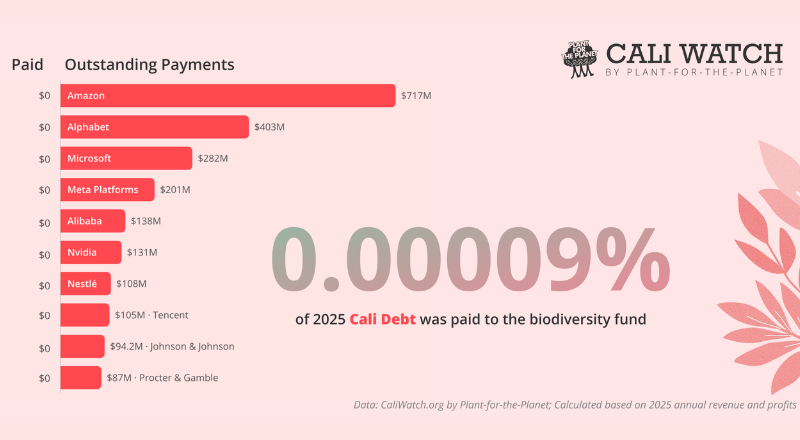
But the lack of contributions is not just a question of corporate responsibility. No country has yet introduced legislation requiring companies to contribute to the Cali Fund. The international agreement invites governments to take administrative, policy or legislative measures to encourage or require payments. Cali Watch therefore also features a legislation tracker that monitors national efforts to introduce such measures. By bringing together information on company contributions and government action, the platform aims to strengthen transparency and support efforts to turn the Cali Fund’s promise into meaningful funding for biodiversity and the Indigenous Peoples and local communities who protect it.
What’s next for the Cali Fund? COP17 and beyond
The next major milestone is the 17th Conference of the Parties to the Convention on Biological Diversity (COP17), scheduled to take place in Yerevan, Armenia, from 19 to 30 October 2026.
Governments are expected to discuss important outstanding questions about how the Cali Fund will operate and how it can mobilise greater financial contributions. A central question is whether contributions will remain voluntary or whether governments will introduce national measures to encourage or require companies to pay.
Explore Cali Watch: caliwatch.org
Get updates on the Cali Fund during COP17 on WhatsApp here.
 10.13.26
CBD COP17 Explained: What the UN Biodiversity Summit Means for Nature
When most people hear the word “COP,” their minds immediately jump to the famous climate conference, the massive UN summits where world leaders, diplomats,…- 10.13.26
The Cali Fund: Companies Can Help Protect Global Biodiversity
Every day, we use products that rely on nature in ways we may not even realise. Skincare and cosmetics, medicines and even the food…  10.05.26
Youth Summit 2026: Stronger together for climate, community and democracy
Centered around the theme “Stronger together: climate, community, democracy”, around 60 participants from more than 15 countries representing 6 continents came together this year… 09.28.26
Brazil’s 2026 Election: What Does It Mean for the Future of the Amazon?
Brazil’s presidential election in October 2026 could have far-reaching consequences for the future of the Amazon rainforest. With almost two-thirds of the Amazon located… 09.22.26
Climate Myths from the Comment Section
As early as 1912, it was publicly reported that the increasing burning of fossil fuels could alter the concentration of greenhouse gases in the… 09.15.26
Together, We Can Achieve More: Key Takeaways from the F20 Climate Solutions Forum 2026
Political space for action is shrinking, international consensus on climate action is becoming increasingly fragile, and geopolitical tensions are on the rise. At the…


