

July 20, 2026

Victoria Krumbeck
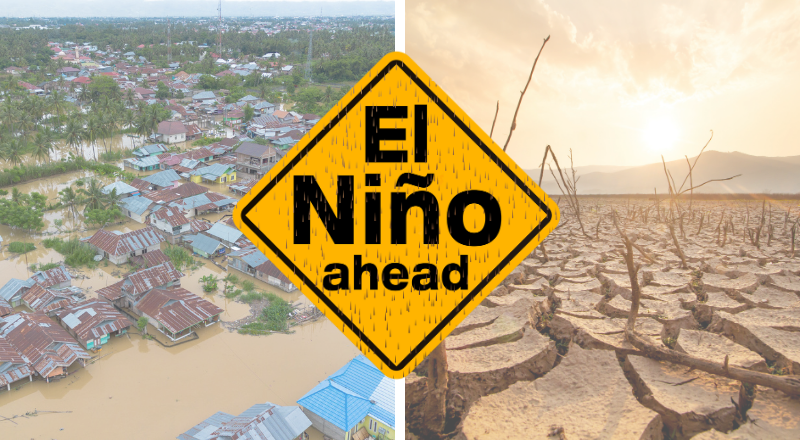
Europe has been gripped by record-breaking heat in recent weeks, with the second-warmest June ever recorded. At the same time, scientists continue to report new findings about the climate phenomenon El Niño, which is expected to intensify extreme weather events around the world. But what exactly is El Niño, and how could it affect us?
Temperatures exceeded 40°C several times across multiple European countries, including Germany (41.7°C), France (43.8°C), Spain (42.7°C), as well as Austria, Poland, Hungary and the Czech Republic. Only in 2019 has Europe experienced a hotter June since weather records began. Other parts of the world also faced exceptional heat, including the eastern United States, Sub-Saharan Africa, and South and Central Asia. In many parts of Asia, extreme heat has persisted for months, with temperatures approaching 50°C.
As we already know, the climate crisis is making extreme weather events like these more frequent and more intense. The likelihood of experiencing additional heatwaves in the coming weeks remains high. At the same time, organizations such as the World Meteorological Organization (WMO) warn that El Niño is likely to amplify extreme weather patterns around the globe. Its influence is expected to become particularly noticeable in many regions towards the end of the year.
What Is El Niño?
To understand how El Niño could affect global weather, it is important to first understand what the phenomenon actually is. El Niño is one phase of the El Niño–Southern Oscillation (ENSO), a naturally occurring climate cycle that typically develops every two to seven years. It has a major influence on the trade winds across the Pacific Ocean. Under neutral conditions, the trade winds blow from South America towards Southeast Asia, pushing warm surface water westward across the Pacific. At the same time, cold, nutrient-rich water rises to the surface along the west coast of South America in a process known as upwelling. The warm water near Southeast Asia evaporates, producing heavy rainfall over land. The cooled air then circulates back towards South America, contributing to dry weather conditions there.
Over time, however, the trade winds can weaken or even reverse. When this happens, an El Niño event develops. Without the usual winds pushing warm water westward, the warm water spreads back across the central and eastern Pacific, including the waters off the coast of South America. This shift alters rainfall patterns and atmospheric circulation. As a result, sea surface temperatures off South America can become warmer than those around Southeast Asia. Heavy rainfall often occurs in parts of South America, while Southeast Asia experiences unusually dry conditions. The opposite phase of this cycle is known as La Niña, which strengthens the normal trade wind pattern and generally produces opposite weather effects.
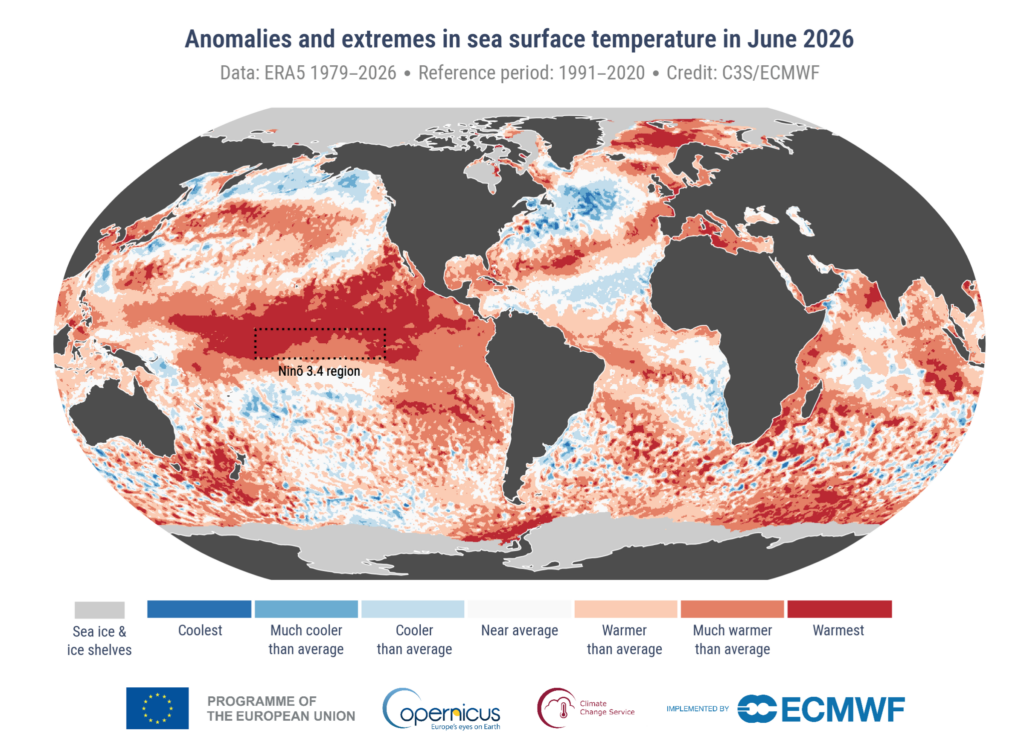
Not every El Niño event is equally strong. However, according to the WMO, there was an 80% probability that El Niño would develop between June and August. Rising ocean temperatures already provide clear evidence that the phenomenon is underway.
What Are the Global Impacts of El Niño?
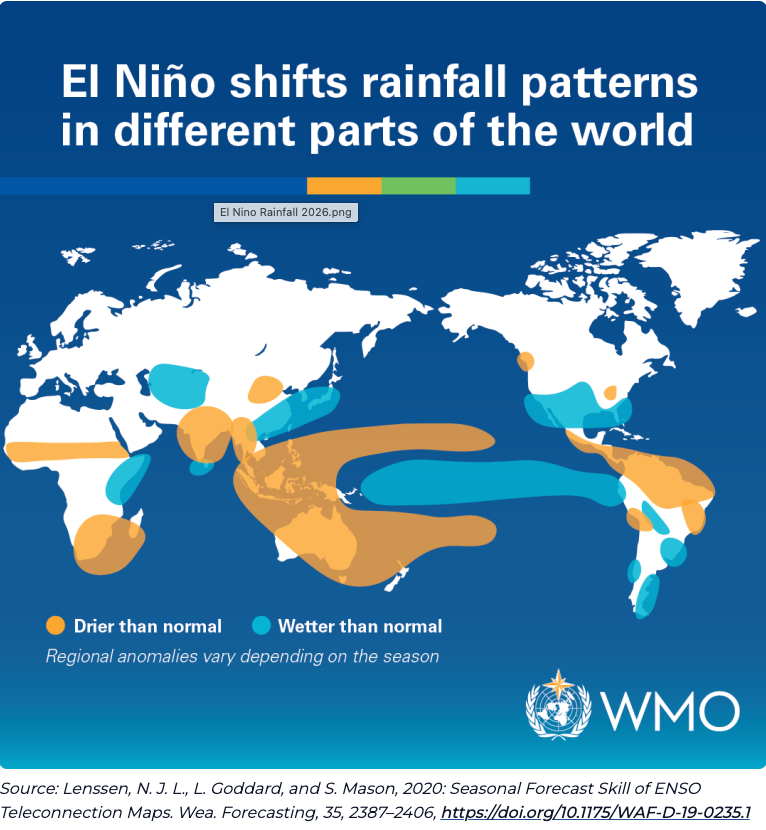
The effects of El Niño include droughts and floods, which can affect different regions around the world in different ways. According to the World Resources Institute, areas that may be particularly vulnerable to drought include the Caribbean, Central America, northern Brazil, central and northern India, Central and Southern Africa, Indonesia, the Philippines and Australia. In contrast, increased rainfall and flooding could occur in the southern United States, parts of Peru, Ecuador, East Africa, as well as regions of the Middle East and Central Asia. However, the peak impact of El Niño is not expected until the end of this year and the beginning of the next.
Current forecasts suggest that the upcoming El Niño could be exceptionally strong, with some experts even referring to it as a “super El Niño.” Its impacts could range from crop failures and water shortages to the loss of grazing land. As a result, livestock may die or have to be sold, leaving many people without their primary source of income and livelihood. At the same time, hunger and food insecurity could worsen, while rising food prices may place even greater pressure on vulnerable communities and further weaken local economies. Communities in countries already affected by the climate crisis, conflict, poverty or economic instability are likely to be hit hardest. For some people, these combined pressures could ultimately force them to leave their homes.
The impacts of a strong El Niño are well documented. According to the UN Food and Agriculture Organization (FAO), more than 60 million people were affected by the 2015–2016 El Niño event. In 23 countries, the resulting humanitarian response required approximately US$5 billion in aid.
How Does El Niño Affect Europe?
For Europe, El Niño does not initially have a direct impact. The continent is generally less affected by the immediate consequences of the phenomenon. However, changes caused by El Niño can influence European weather patterns. For example, El Niño can affect the jet stream, which plays a key role in determining weather conditions across Europe. It may also influence the polar vortex, potentially contributing to colder late winters. In some cases, this can allow cold Arctic air to move further south while warmer air shifts further north.
Therefore, when Europe experiences summer heatwaves, the main cause is not El Niño. These extreme temperatures are primarily a result of the climate crisis, which is increasing the frequency and intensity of heat events. The influence of El Niño is expected to become more noticeable later in the year. For regions directly affected by El Niño, however, the consequences can be much more severe. When El Niño occurs alongside already elevated ocean temperatures, the likelihood of extreme events such as droughts and floods increases significantly.
El Niño and the Climate Crisis: Challenges for Ecosystem Restoration
Our ecosystem restoration team also needs to adapt to changing conditions. In our Plant-for-Ghana project, we expect a high risk of prolonged droughts. At the same time, we anticipate lower levels of rainfall and rising temperatures. These conditions also increase the risk of wildfires, as we have already experienced in Mexico. Due to these challenges, we expect a shorter planting season.
“This year’s El Niño is expected to lead to extreme weather conditions around the world. In Ghana, we anticipate that the dry season will begin earlier, meaning that we will have a shorter window for planting. When a young tree is newly planted, its roots are not yet large enough to access water from deeper soil layers. For this reason, we only plant trees when there is enough rainfall to keep the soil moist for at least one month after planting,” explains Dr. Anna Gee, Project Manager for Ecosystem Restoration and Forest Protection at Plant-for-the-Planet.
Despite these forecasts, we will continue our work in our planting areas. However, we must adapt to external factors such as El Niño to ensure that as many seedlings as possible can withstand the changing conditions and survive.
Would you like to support our work in Ghana? Click here to learn more.
 10.13.26
The Cali Fund: Companies Can Help Protect Global Biodiversity
Every day, we use products that rely on nature in ways we may not even realise. Skincare and cosmetics, medicines and even the food…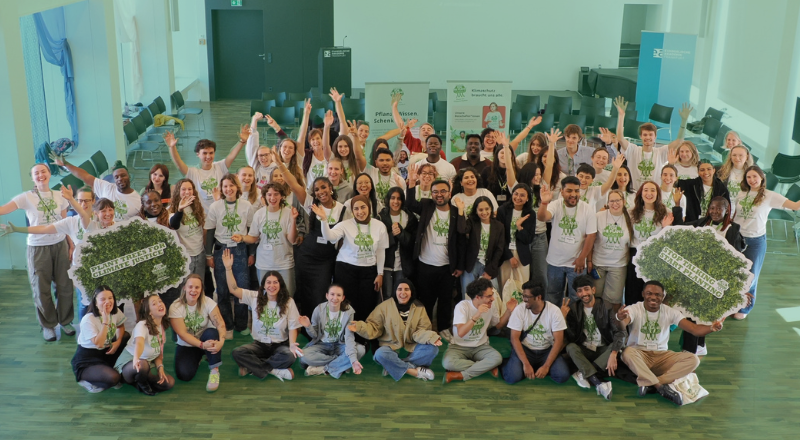 10.05.26
Youth Summit 2026: Stronger together for climate, community and democracy
Centered around the theme “Stronger together: climate, community, democracy”, around 60 participants from more than 15 countries representing 6 continents came together this year…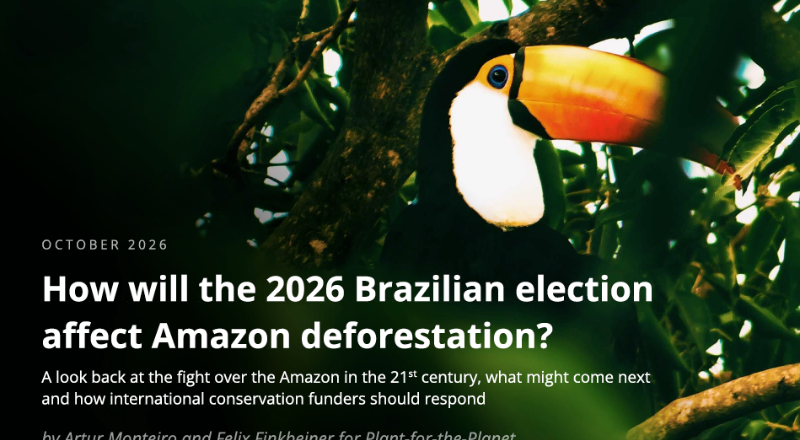 09.28.26
Brazil’s 2026 Election: What Does It Mean for the Future of the Amazon?
Brazil’s presidential election in October 2026 could have far-reaching consequences for the future of the Amazon rainforest. With almost two-thirds of the Amazon located… 09.22.26
Climate Myths from the Comment Section
As early as 1912, it was publicly reported that the increasing burning of fossil fuels could alter the concentration of greenhouse gases in the…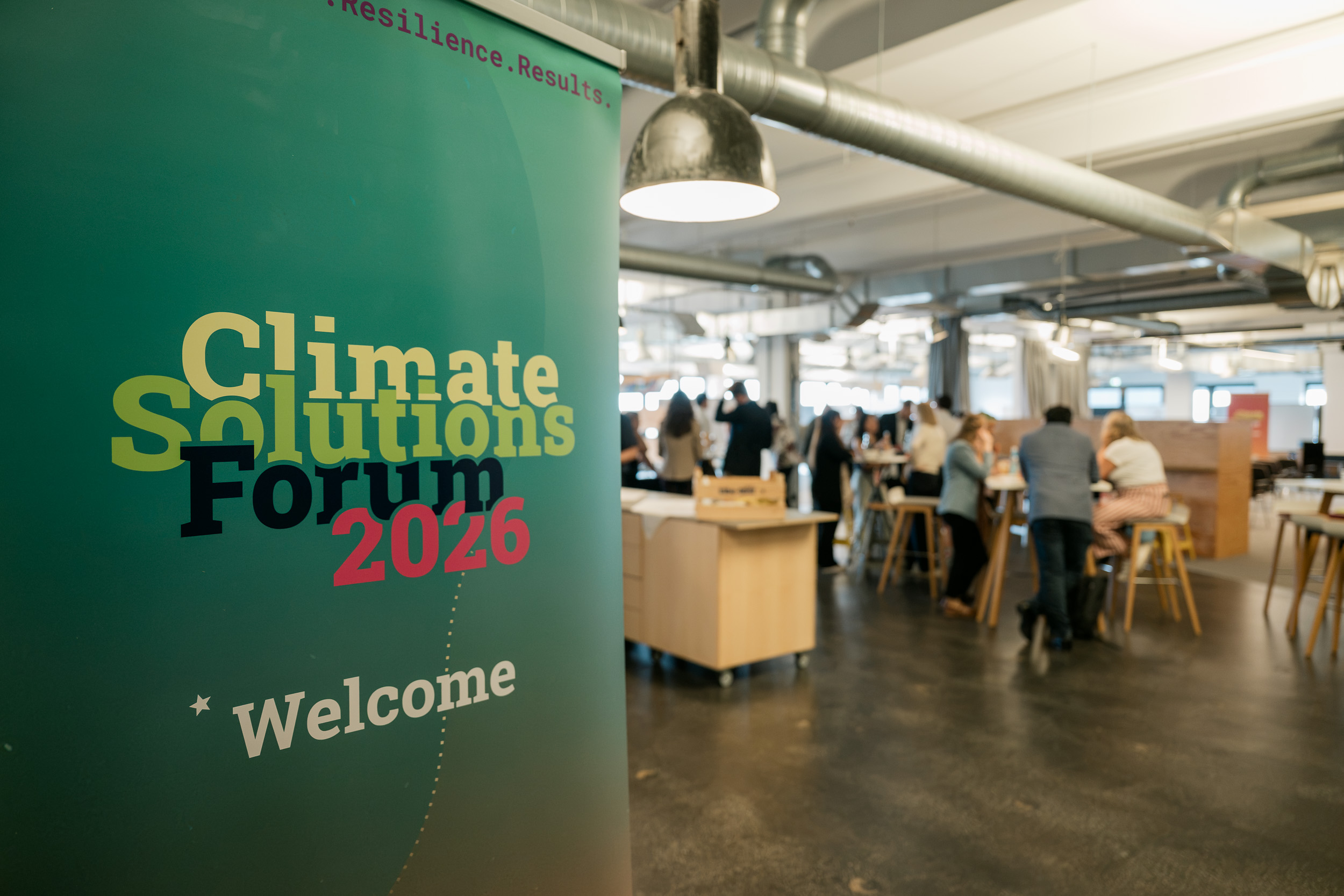 09.15.26
Together, We Can Achieve More: Key Takeaways from the F20 Climate Solutions Forum 2026
Political space for action is shrinking, international consensus on climate action is becoming increasingly fragile, and geopolitical tensions are on the rise. At the…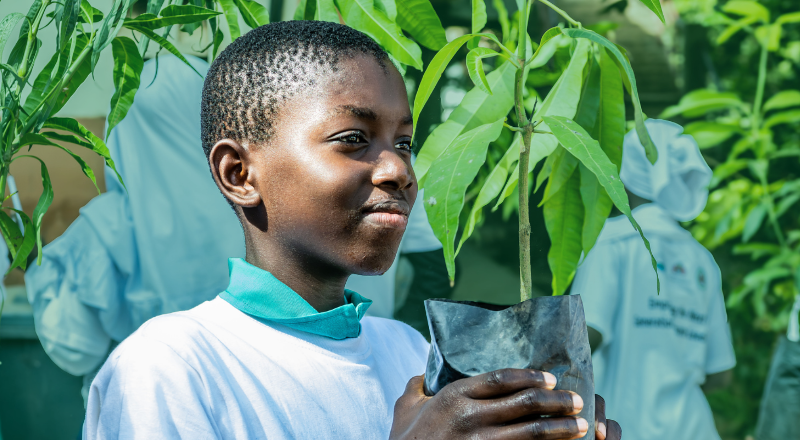 09.03.26
Why Climate Education for Children Starts with One Mentor or One Academy.
A regular, floody day in The Gambia. It is 9 am on a September Tuesday on the “Smiling Coast of Africa”. The dry season…


